PT Indomobil Sukses Internasional Tbk (IMAS, Rp5.300, BUY, TP Rp6.000) established a joint venture with a Japanese automotive parts retailer, Autobacs Seven. Through its subsidiary, PT Central Sole Agency, IMAS established PT Autobacs Indomobil Indonesia to reach the wholesale distribution market of auto parts and accessories.
The amount disbursed for capital in this joint venture is U.S. $ 18 million or equivalent to Rp 181,18 billion, where as many as 51% of the portion owned by Central Sole and 49% owned by Autobacs.
Autobacs Seven is a pioneer of one-stop retail and department stores in Japan. Their services are automotive goods, services installation, car's selling and buying, car maintenance and inspection, and cars painting.
On the financial statements of 2012 which was recorded in March 2013, Autobacs scored global sales worth 230 billion yen or equivalent to Rp 23,26 trillion, and net profit of 8 billion yen or equivalent to Rp 809,25 billion. In the global network, the company has 552 stores in Japan and 27 stores in other countries. [11 in France, 6 in Taiwan, 4 in Thailand, 3 in Singapore, 2 in China and 1 in Malaysia]
The subsidiary profits for IMAS is an expectations of increasing demand for car accessories which associated with car sales increased and Indonesian population demographics. The subsidiary can help IMAS to strengthen the auto parts business in 2012 by contributing gross profit of 25%.
For long term, IMAS predict its new subsidiary will add 3% -5% of company revenue and will make its net margin improved compared to segment dealers.
In terms of consolidation, the contribution of Autobacs Indomobil will donate 2% -3% for IMAS' net income proportionately on 51% ownership. This business is likely to commence in 2014 with the opening of a new store in Serpong area.
The investment cost for the next 3 years is expected at U.S. $ 6 million, equivalent to Rp 60,42 billion, mainly for 5 stores opening in 2014, 10 stores in 2015 and 10 stores in 2016. The business is also open for franchise opportunities.
for Indonesia Market Summaries
Showing posts with label Indonesia Automotives sales. Show all posts
Showing posts with label Indonesia Automotives sales. Show all posts
Tuesday, July 23, 2013

Friday, July 19, 2013
PT Indomobil Sukses Internasional Tbk started to introduce Datsun
Nissan, One of the principal of PT Indomobil Sukses Internasional Tbk (IMAS, Rp5.400, BUY, TP Rp6.000) started to introduce their plan to launching Datsun.
Bisnis Indonesia reported that Nissan will increase the capacity of their assembly plant annually from 100,000 units to 150,000 units by the end of 2014 and 200,000 units in 2016, so the total allocated budget worth U.S. $ 200 million. From total capacity of 200,000 units per year, Nissan Motor Indonesia (NMI) will allocate 50% total capacity to Datsun.
Datsun debut will begin on September 17 when the two types of low cost green car (LCGC) launch. Non-LCGC production cars will be the next target. NMI stated that the first type of Datsun will be different from Datsun GO that launched in India three days ago.

for Indonesia Market Summaries
Bisnis Indonesia reported that Nissan will increase the capacity of their assembly plant annually from 100,000 units to 150,000 units by the end of 2014 and 200,000 units in 2016, so the total allocated budget worth U.S. $ 200 million. From total capacity of 200,000 units per year, Nissan Motor Indonesia (NMI) will allocate 50% total capacity to Datsun.
Datsun debut will begin on September 17 when the two types of low cost green car (LCGC) launch. Non-LCGC production cars will be the next target. NMI stated that the first type of Datsun will be different from Datsun GO that launched in India three days ago.
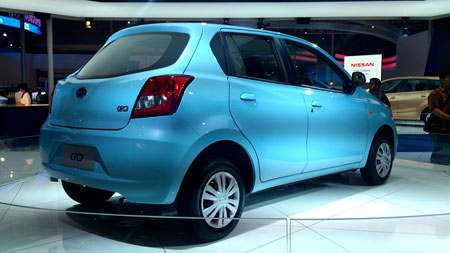
Revers to total capacity production has been targeted by NMI, 100% utilization would make Datsun able to sell as many as 8,300 units in 2016. For 2014, we have projected that as many as 2,500 monthly sales will be started in quarter II/2014 and will contribute 22,500 unit sales for the full year.for Indonesia Market Summaries
Tuesday, July 16, 2013
Indonesia Market Summaries 16 July 2013
Japanese car manufacturer, Nissan, began to introduce low cost green car (LCGC) Datsun GO, the price of Datsun GO type in India today are INR400.000 or USD 6.700 or around IDR 67 million. In Indonesia, distributor for Nissan and Datsun is PT Indomobil Sukses Internasional Tbk (IMAS, Rp5.350, BUY, TP Rp6.000).
Cars with a capacity of five people was also the first Datsun LCGC which will be released in 2014 in Indonesia, Russia, and South African. Next the LCGC is a versatile type (multi-purpose vehicles / MPV) with a capacity of 7 people. Other manufacturers which is planning to release a 7 MPV capacity is Honda, while the other principals such as Toyota, Daihatsu, and Suzuki has not revealed similar plans.
While the market share of automotive vehicles (4W) PT Astra International Tbk (ASII, Rp6.650, NEUTRAL, TP Rp7.300) and IMAS down in June. The decline occurred even the car sales in the industry increased by 4.7% MoM and 2.5% YoY to 104.265 units.
The increase was supported by higher sales by Suzuki (+55.7% mom) and Mitsubishi (+11.7%), meanwhile Toyota (-3.2% mom), Daihatsu (-6.6% mom), Nissan (-8.1% mom), and Honda (-9.2% mom).
As a result of that achievement, ASII market share fell to 50.9% in June (down by -4.4 percent points MoM and -2.6 percent points YoY) or 53.4% during the semester I/2013 (down -3.0 percent points). For IMAS (just Nissan), its market share also fell to 5.2% in June (down -0.7 percent point MoM and -0.5 percent points YoY) and amounted to -1.2 percent points throughout the semester I/2013.
For the semester I/2013, car sales are recorded as many as 601 952 units (up +12.5% YoY), which is 47.8% from the target of 1,259,008 units this year, compared with the realization of 48%. Sales in the quarter II/2013 rose 3.4% quarter on quarter (QoQ) or 7.6% year on year (YoY) to 306,036 units.
for Indonesia Market Summaries 16 July 2013
Cars with a capacity of five people was also the first Datsun LCGC which will be released in 2014 in Indonesia, Russia, and South African. Next the LCGC is a versatile type (multi-purpose vehicles / MPV) with a capacity of 7 people. Other manufacturers which is planning to release a 7 MPV capacity is Honda, while the other principals such as Toyota, Daihatsu, and Suzuki has not revealed similar plans.
While the market share of automotive vehicles (4W) PT Astra International Tbk (ASII, Rp6.650, NEUTRAL, TP Rp7.300) and IMAS down in June. The decline occurred even the car sales in the industry increased by 4.7% MoM and 2.5% YoY to 104.265 units.
The increase was supported by higher sales by Suzuki (+55.7% mom) and Mitsubishi (+11.7%), meanwhile Toyota (-3.2% mom), Daihatsu (-6.6% mom), Nissan (-8.1% mom), and Honda (-9.2% mom).
As a result of that achievement, ASII market share fell to 50.9% in June (down by -4.4 percent points MoM and -2.6 percent points YoY) or 53.4% during the semester I/2013 (down -3.0 percent points). For IMAS (just Nissan), its market share also fell to 5.2% in June (down -0.7 percent point MoM and -0.5 percent points YoY) and amounted to -1.2 percent points throughout the semester I/2013.
For the semester I/2013, car sales are recorded as many as 601 952 units (up +12.5% YoY), which is 47.8% from the target of 1,259,008 units this year, compared with the realization of 48%. Sales in the quarter II/2013 rose 3.4% quarter on quarter (QoQ) or 7.6% year on year (YoY) to 306,036 units.
for Indonesia Market Summaries 16 July 2013
Monday, April 15, 2013
Indonesia Automotives sales is on the right track at first-quarter 2013
Official March auto sales were released on Friday; both aligned with preliminary data. Performances are relatively on-track with bias upward revision on the 4W segment, but we remain vigilant on the government’s plan in announcing a new policy limiting fuel subsidy, which may give a negative sentiment in the short-term. Maintain Neutral on ASII (TP: Rp7,900) and Buy on IMAS (TP: Rp6,150)
4W sales came at 95,936 units (+9.1%yoy; -7.1%mom). Considering the very strong February sales at 103,284 units, the reduction in March volume should not be considered a weakening trend as it is also still higher than the monthly average volume during the strong 2H12 at 96,828 units. As we all know, 2H volumes are seasonally higher than 1H. Toyota volumes weaken by 1.7%yoy or 7.2%mom, though it reportedly managed to sell 1,289 units of Etios Valco (launched on March 11). However, Astra’s performance was strongly offset by the strong sales of Daihatsu (+19.6%yoy; +15.5%mom). Nissan, on the other hand, booked a very weak sales of 4,648 units (-24.5%mom; -22.5%yoy).
On cumulative basis, 1Q13 4W sales came at 295,909 units (+18.0%yoy; -1.3%qoq), accounting for 24.2% of our 1.2mn units full-year estimate (+9.6%yoy), versus historical realization of 24.3% on average (range: 19.4-27.0%). The strong growth was driven by Honda (+228.8%yoy; +16.7%qoq) and Suzuki (+70.4%yoy; -6.4%qoq), mostly due to strong products launching (i.e. Honda CRV, Honda Brio, Suzuki Ertiga).
On the 2W segment, March sales came at 665,334 units (+7.4%yoy, +2.4%mom), marking the highest sales since February 2012, likely due to the effect of fast-forwarded sales ahead of the effective implementation of LTV ruling for sharia banks on April 1. Industry growth was mostly driven by Honda (+26.0%yoy; +2.4%mom), thanks to its aggressive new products launching and strong dominance in the less-sensitive upper-class 2W models.
Cumulatively, 1Q13 2W sales came at 1.9mn units (+1.5%yoy; +3.0%qoq), accounting for 26.4% of our full-year forecast of 7.4mn units (+5.1%yoy). Honda continued to be the outperformer with sales growth of 13.7%yoy and 17.9%qoq, boosting its market share to 61.7%. That said, Honda’s performance is already ahead as it has achieved 27.6% of our full-year estimates of 4.3mn units (+7.2%yoy). We expect Honda to experience a milder impact from the sharia law.
As we had highlighted in our earlier Sector Report on March 14, regulation noise from the government’s plan to curb fuel subsidy spending remains the concern going forward. If the government decides to raise the subsidized fuel price, historical patterns suggests a short-term negative impact of 3-6 months long for auto sales. In our view, the announcement of fuel subsidy policy would also be the key to pave the way for the release of LCGC regulation, which had been delayed.
4W sales came at 95,936 units (+9.1%yoy; -7.1%mom). Considering the very strong February sales at 103,284 units, the reduction in March volume should not be considered a weakening trend as it is also still higher than the monthly average volume during the strong 2H12 at 96,828 units. As we all know, 2H volumes are seasonally higher than 1H. Toyota volumes weaken by 1.7%yoy or 7.2%mom, though it reportedly managed to sell 1,289 units of Etios Valco (launched on March 11). However, Astra’s performance was strongly offset by the strong sales of Daihatsu (+19.6%yoy; +15.5%mom). Nissan, on the other hand, booked a very weak sales of 4,648 units (-24.5%mom; -22.5%yoy).
On cumulative basis, 1Q13 4W sales came at 295,909 units (+18.0%yoy; -1.3%qoq), accounting for 24.2% of our 1.2mn units full-year estimate (+9.6%yoy), versus historical realization of 24.3% on average (range: 19.4-27.0%). The strong growth was driven by Honda (+228.8%yoy; +16.7%qoq) and Suzuki (+70.4%yoy; -6.4%qoq), mostly due to strong products launching (i.e. Honda CRV, Honda Brio, Suzuki Ertiga).
On the 2W segment, March sales came at 665,334 units (+7.4%yoy, +2.4%mom), marking the highest sales since February 2012, likely due to the effect of fast-forwarded sales ahead of the effective implementation of LTV ruling for sharia banks on April 1. Industry growth was mostly driven by Honda (+26.0%yoy; +2.4%mom), thanks to its aggressive new products launching and strong dominance in the less-sensitive upper-class 2W models.
Cumulatively, 1Q13 2W sales came at 1.9mn units (+1.5%yoy; +3.0%qoq), accounting for 26.4% of our full-year forecast of 7.4mn units (+5.1%yoy). Honda continued to be the outperformer with sales growth of 13.7%yoy and 17.9%qoq, boosting its market share to 61.7%. That said, Honda’s performance is already ahead as it has achieved 27.6% of our full-year estimates of 4.3mn units (+7.2%yoy). We expect Honda to experience a milder impact from the sharia law.
As we had highlighted in our earlier Sector Report on March 14, regulation noise from the government’s plan to curb fuel subsidy spending remains the concern going forward. If the government decides to raise the subsidized fuel price, historical patterns suggests a short-term negative impact of 3-6 months long for auto sales. In our view, the announcement of fuel subsidy policy would also be the key to pave the way for the release of LCGC regulation, which had been delayed.
Subscribe to:
Posts (Atom)